 Back to Blogs
The Magnetic Levels — Why Price Gets Drawn to Certain Numbers Near Expiry
What is max pain in options trading?
Max pain is the candidate settlement price that minimizes the aggregate intrinsic payout on outstanding calls and puts, weighted by current open interest. It does not measure premiums retained or count how many contracts expire worthless. Put and call concentrations add positioning context, but these readings do not guarantee a range or a settlement price.
Illustrative expiry-afternoon example, not a historical record: NIFTY has been drifting all day toward a round number it had previously traded through. Your chart shows no support there. No trendline. No moving average. And yet price settles within 30 points of 23,500 by close, as if something invisible is pulling it.
Illustrative expiry-afternoon example, not a historical record: NIFTY has been drifting all day toward a round number it had previously traded through. Your chart shows no support there. No trendline. No moving average. And yet price settles within 30 points of 23,500 by close, as if something invisible is pulling it.
You've seen this pattern before. The 500-point intervals on NIFTY, the 50-point marks on Bank Nifty in the final hours of expiry day. The gravity is consistent enough to feel intentional, but your charts offer no explanation for it.
That's because the force isn't on your chart. It's in the options chain. Near expiry, a completely different set of mechanics shapes where price gravitates. These mechanics have nothing to do with candlestick patterns, moving averages, or trendlines, and everything to do with where the most money is concentrated in outstanding options contracts.
How Open Interest Concentration Shapes Price Near Expiry
Open interest at specific strike prices represents the total number of outstanding options contracts that haven't been closed or exercised, and strikes with the highest concentration act as gravitational anchors for price in the final sessions before expiry because both buyers and sellers have strong financial incentives to defend or attack those levels.
Think of open interest as a map of where traders have placed their bets. On any given NIFTY monthly expiry, certain strikes accumulate far more contracts than others. The 23,000 strike might hold 15 million contracts while the 23,050 strike holds 2 million. That concentration isn't random. Round numbers attract positioning because they're psychologically significant, and institutional hedging strategies cluster around them.
The concentration matters because it creates opposing forces at those specific levels. If the 23,500 call strike has heavy open interest, call buyers need price above 23,500 to profit, while call sellers need it below. If the 23,000 put strike has heavy open interest, put buyers need price below 23,000, while put sellers need it above. These opposing interests create tension that pulls price toward the zones where the most contracts expire worthless.
The same dynamic plays out on SPX options in the US. Weekly Friday expiries on SPX show similar clustering around round strikes, with price often settling within a narrow band of the highest-OI levels in the final trading hours. Ni, Pearson, and Poteshman documented this effect in their 2005 study published in the Journal of Financial Economics, finding statistically significant stock price clustering on option expiration dates, driven by the hedging and unwinding activity of market participants holding large options positions.
What Max Pain Is and Why It Creates a Gravity Well
Max pain is a minimum-payout calculation: for each candidate settlement price, add the intrinsic value owed on outstanding calls and puts using current open interest. The candidate with the lowest total is the calculated max-pain level. Zerodha Varsity illustrates this calculation.
For each candidate settlement price, a call contributes the amount above its strike, if positive; a put contributes the amount below its strike, if positive. Weight those amounts by open interest and the applicable contract size, then sum across strikes. This does not recover the premiums at which participants opened their positions.
Open interest alone does not identify which side dealers hold or whether their positions are directional, hedged, or part of a spread. A minimum aggregate payout is not evidence that participants can or will steer the market to that price.
Delta hedging can affect trading flows, but its direction depends on the actual positions and how they change. The max-pain calculation alone cannot establish those flows or demonstrate that price will be pinned.
For NIFTY monthly expiries, use the open interest for that specific contract. Calculate aggregate intrinsic payout at each candidate price and select the minimum. The strike with the most combined open interest is not necessarily the minimum-payout price.
On SPX, the same principle applies. Friday-expiry 0DTE options on SPX show a compressed version of this gravity, with max pain often exerting its pull within the final two hours of trading as gamma increases and hedging adjustments accelerate.
How Put Walls and Call Walls Create a Trading Range
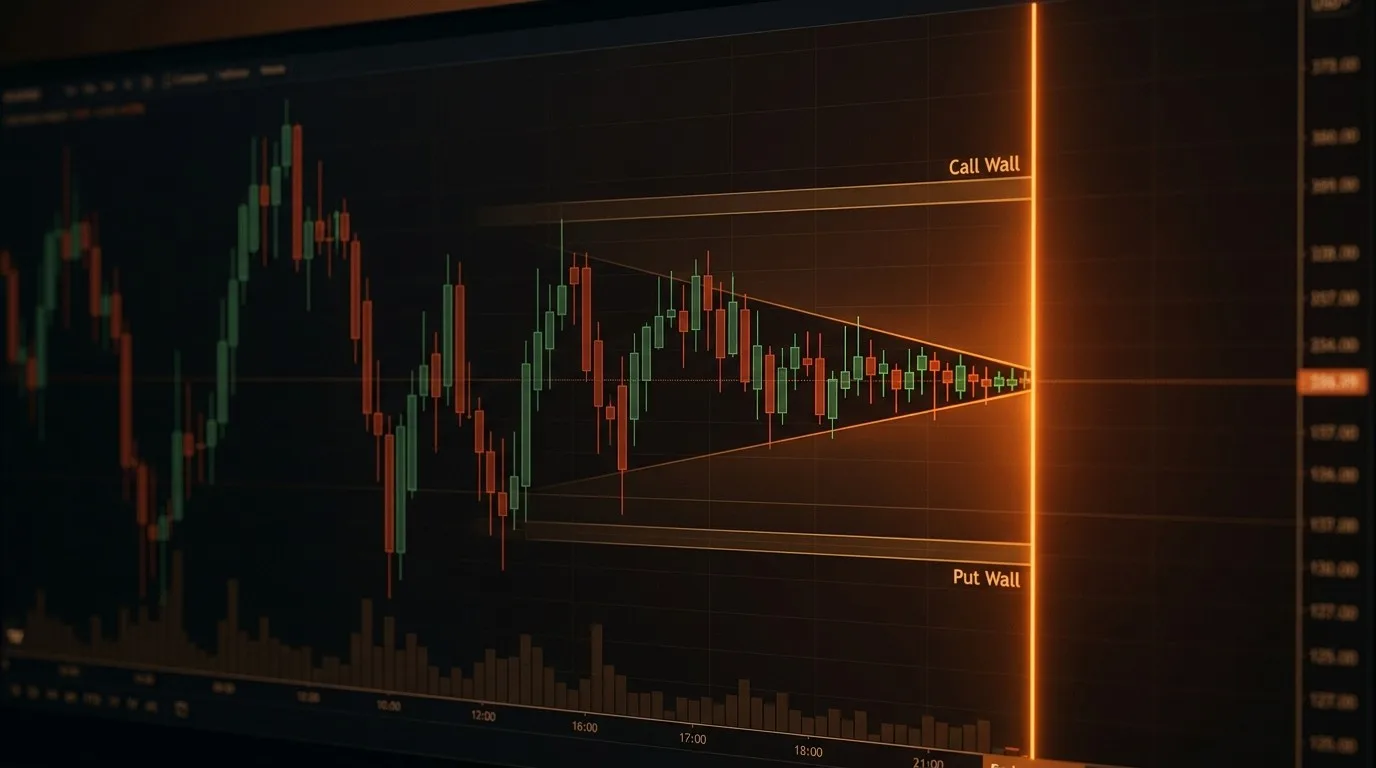
The put wall is commonly used to mean the strike with the highest put open interest; the call wall is the corresponding call concentration. These are levels to examine, not automatic support and resistance. Open interest does not reveal dealer-side ownership or the net hedge of the wider portfolio.
A short put has positive delta. In a simple delta-neutral hedge, that exposure is offset by selling the underlying or an appropriate futures equivalent. A put concentration therefore does not, by itself, imply hedging-related buying or a price floor.
A short call has negative delta. In a simple delta-neutral hedge, that exposure is offset by buying the underlying or an appropriate futures equivalent. These hedge directions follow the delta signs explained by the Options Industry Council. Actual market flows depend on net positions, existing hedges, and adjustments, which open interest alone does not establish.
The distance between put and call concentrations describes where outstanding contracts cluster. It does not, by itself, establish an expected trading range. If price repeatedly responds near those levels and flow supports that observation, a range interpretation may be reasonable. A break or conflicting flow weakens that interpretation; neither concentration guarantees hedging resistance.
For example, a call concentration 50 points above NIFTY and a put concentration 100 points below identify nearby levels to investigate. Compare the observed price response, changes in open interest, and flow at each level. The concentrations alone do not establish selling pressure above price or a buying floor below it.
SEBI's January 2023 study, "Analysis of Profit and Loss of Individual Traders dealing in Equity F&O Segment," found that 89% of individual traders in the Indian derivatives segment incurred net losses. While the study attributed losses to multiple factors, the structural information asymmetry around options positioning is one dimension where retail traders consistently operate at a disadvantage. Institutional participants can see and model the OI landscape, the max pain calculation, and the put/call wall positioning in real time. Most retail traders trade near expiry without any of this context.
What Happens After Expiry Resets the Board
After a major expiry, open interest resets and new positioning begins within the first 48 hours. These initial sessions typically show lower volume, wider bid-ask spreads, and fresh OI buildup at new strikes that reveals the early directional bias for the next cycle before most traders have redrawn their chart levels.
This post-expiry window is one of the most underwritten topics in options education, and it follows directly from understanding expiry mechanics. If OI concentration creates gravity, then the absence of that concentration immediately after expiry means the gravitational forces are temporarily gone. Price can move more freely. And the specific strikes where new OI starts building in the first two sessions tell you where the next cycle's gravity wells are forming.
Consider an illustrative example. A monthly NIFTY contract expires on the last Tuesday of the month at 23,480, near max pain of 23,500. In the next trading session, you notice heavy put writing at the 23,200 strike and heavy call writing at 23,800. The new put wall and call wall are forming, and the range they define is wider than the previous week's. That signals the options market expects a wider trading range in the coming cycle, which is itself useful context for sizing and stop placement.
On SPX, the cycle is even faster because of daily 0DTE expirations. The OI map resets every session, meaning the gravitational forces rebuild fresh each morning. For weekly and monthly SPX expiries, the post-expiry OI rebuild follows the same pattern, just compressed into hours rather than days.
Putting the Expiry Map Into Practice
When reviewing a directional thesis within three sessions of a NIFTY or Bank Nifty expiry, compare three observations. First, where is max pain relative to the latest price and the preceding session's positioning? Distance alone does not predict a move toward it. Second, where are put and call contracts concentrated, and how has price actually responded near those levels? Third, does current flow support or contradict the thesis? These observations help compare scenarios without assuming that either concentration creates a fixed range or a particular hedge direction.
None of this replaces your chart analysis. It adds a layer your chart can't show you. And that layer often explains why price "randomly" stopped at a level that had no visible support or resistance.
Draconic, an AI trading intelligence platform, synthesizes OI concentration, max pain, and put/call wall positioning alongside price dynamics, flow, and structural analysis in a single view. Instead of switching between your charting platform and the NSE options chain page, you can ask one question and see where the gravitational zones sit for this expiry, mapped against the technical and flow picture.
The chart shows where price has been. The options chain shows where the money is. Near expiry, the money often wins.
Frequently Asked Questions
Does max pain actually predict where NIFTY will settle on expiry day?
No. It identifies the candidate settlement price with the lowest aggregate intrinsic payout based on current open interest. It does not include entry premiums, identify dealer positions, or guarantee where NIFTY will settle.
No. It identifies the candidate settlement price with the lowest aggregate intrinsic payout based on current open interest. It does not include entry premiums, identify dealer positions, or guarantee where NIFTY will settle.
Can I use put wall and call wall levels as support and resistance?
They are positioning reference levels, not guaranteed support or resistance. Compare the concentration with price, flow, and the source's gamma assumptions; open interest alone does not establish the direction of hedging pressure.
They are positioning reference levels, not guaranteed support or resistance. Compare the concentration with price, flow, and the source's gamma assumptions; open interest alone does not establish the direction of hedging pressure.
Does Bank Nifty still have weekly options?
No. As checked on 16 September 2026, NSE lists BANKNIFTY monthly and quarterly contracts. Expiry is the last Tuesday of the expiry period, or the previous trading day if Tuesday is a holiday. Use the selected contract's date and positioning rather than assuming a weekly cycle.
No. As checked on 16 September 2026, NSE lists BANKNIFTY monthly and quarterly contracts. Expiry is the last Tuesday of the expiry period, or the previous trading day if Tuesday is a holiday. Use the selected contract's date and positioning rather than assuming a weekly cycle.
How soon after expiry should I start watching new OI buildup?
Compare the new contract's positioning across the following sessions. There is no fixed time by which its put and call concentrations must be established. Check the source timestamp and the selected expiry before comparing observations.
Compare the new contract's positioning across the following sessions. There is no fixed time by which its put and call concentrations must be established. Check the source timestamp and the selected expiry before comparing observations.
Does this work for US options on SPX?
Yes. SPX options show similar OI concentration, max pain gravity, and put/call wall dynamics. The 0DTE expiry cycle on SPX means these forces rebuild daily, creating a faster gravitational cycle than NIFTY's weekly or monthly structure.
Yes. SPX options show similar OI concentration, max pain gravity, and put/call wall dynamics. The 0DTE expiry cycle on SPX means these forces rebuild daily, creating a faster gravitational cycle than NIFTY's weekly or monthly structure.
More like this
September 9, 2026AI agents · Research
When an AI uses a tool, what happens to the evidence?
Abhinandan • 7 min read
July 4, 2026ai-trading
Chartink Alternative: Draconic vs Chartink
The Draconic Team • 6 min
July 4, 2026ai-trading
Sensibull Alternative: Draconic vs Sensibull
The Draconic Team • 6 min
May 12, 2026behind-the-price
Sector Rotation — The Macro Signal Most Traders Ignore
The Draconic Team • 3 min