 Back to Blogs
Where Smart Money Leaves Footprints — FVG and Order Blocks Explained
What are fair value gaps and order blocks?
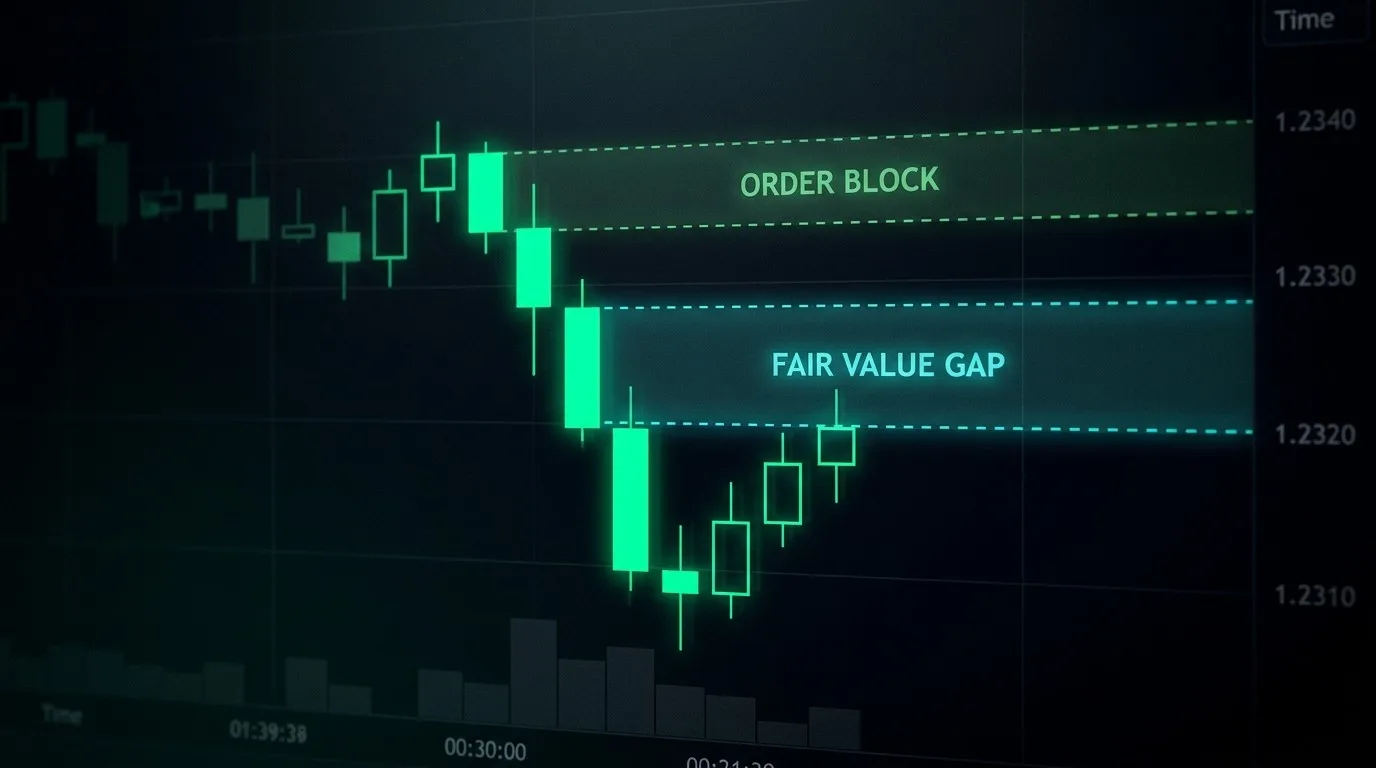
Fair value gaps (FVGs) and order blocks are price zones created by aggressive institutional activity that leave readable structural imprints on the chart. An FVG forms when three consecutive candles fail to overlap, leaving a void from urgent directional movement. An order block is the last opposing candle before an impulsive move — where institutions placed the large orders that propelled the surge. Both can be identified before price returns. Unmitigated zones act as magnets when revisited, across equities, indices, crypto, and forex.
You've watched price drop to a level where no trendline, moving average, or pivot point exists on your chart. It bounces cleanly, as if the level was drawn in invisible ink. You check your indicators. Nothing predicted it. You scan for news. Nothing broke.
These reactions at invisible levels have a structural explanation, and two concepts from smart money analysis reveal the mechanic: fair value gaps and order blocks. Both can be identified from chart structure before price arrives, and both explain why certain zones hold when nothing else on the chart suggests they should.
The levels weren't invisible. They were readable in advance. You just needed to know what to look for.
What Fair Value Gaps and Order Blocks Actually Are
Fair value gaps and order blocks are price zones created by aggressive institutional activity that leave structural imprints on the chart. FVGs form when price moves so fast that consecutive candles fail to overlap. Order blocks mark the last opposing candle before an impulsive move. Both tend to attract price when revisited, and both can be identified before price returns.
These concepts originated from the ICT (Inner Circle Trader) methodology developed by Michael Huddleston and have since become foundational in the broader Smart Money Concepts (SMC) framework used by traders globally. The terminology is relatively recent in retail trading. The underlying behavior, however, is well documented in academic market microstructure research. Institutional traders split large orders across time and price levels because executing a full position at once would move the market against them (Chan & Lakonishok, 1995, "The Behavior of Stock Prices Around Institutional Trades," Journal of Finance, 50(4), 1147–1174). This splitting behavior creates predictable zones where residual institutional interest remains.
What makes FVGs and order blocks different from traditional support and resistance is their derivability. Standard S/R lines are drawn after price reacts. FVGs and order blocks can be identified from chart structure before price returns to test them. That distinction shifts level analysis from reactive to anticipatory.
How Fair Value Gaps Signal Institutional Urgency
A fair value gap forms when three consecutive candles fail to overlap, leaving a visible price void on the chart. This happens when one side moves so aggressively that no trading occurs within part of the price range. The gap represents an imbalance where the market skipped price discovery, and unmitigated gaps tend to act as magnets when price returns.
Here's the mechanic. Take three consecutive candles. In a bullish FVG, the low of candle three sits higher than the high of candle one. That gap between the two prices is the FVG zone. Price moved through that range so quickly that buyers and sellers never transacted there. The market accepted value above and below the zone, but not within it.
Why does this create a magnet? Because markets seek efficiency. An untested price range represents unfinished business. Orders that would have filled in that range never executed. When price returns to the gap, that latent interest activates. Buyers who missed the initial move see the zone as a re-entry point. Sellers who were overwhelmed during the initial surge may attempt to defend it.
The key distinction is mitigation status. An unmitigated FVG is one that price has not yet revisited. It remains an active magnet. Once price returns and trades through the gap, filling it, the FVG is mitigated and its significance diminishes because the imbalance has been resolved.
Consider NIFTY dropping sharply during a session, leaving a bearish FVG near 23,500. Two days later, price rallies back toward that level. The unmitigated gap at 23,500 represents a zone where selling pressure moved so aggressively that no real buying occurred. When price returns, the question is whether the original selling interest is still present. If the FVG holds and price rejects, the zone proved its memory. If price pushes through and fills the gap completely, the imbalance is resolved and the zone loses significance.
How Order Blocks Mark Where Institutions Entered
An order block is the last opposing candle before a strong impulsive move, marking the price zone where institutional traders placed the large orders that propelled the subsequent move. When price returns, the institutional interest that created the original impulse often reasserts itself, making untested blocks high-probability reaction zones across equities, indices, crypto, and forex.
The identification mechanic is straightforward. For a bullish order block, find the last red (bearish) candle before a sharp upward impulse. That candle's range is the order block zone. For a bearish order block, find the last green (bullish) candle before a sharp downward impulse. The concept applies across all markets and timeframes because the institutional behavior it captures is universal.
Why the last opposing candle specifically? Because it represents the final moment where the other side had control before institutions overwhelmed them. The orders placed at that level were large enough to reverse the prevailing direction. And because institutions rarely fill their entire position in a single transaction, residual interest often remains at that price.
Two factors determine an order block's strength. First, mitigation status: an untested order block (price has not yet returned to it) carries higher probability than one already visited. Second, volume at the block: higher volume during the formation candle indicates larger institutional participation, which means more residual interest likely remains.
SPY provides a clean example. Imagine a session where SPY grinds higher, prints one bearish candle near $528.50 as sellers make a final stand, and then surges $3 in four candles. That bearish candle at $528.50 is the bullish order block. Three sessions later, SPY pulls back to $528.80. Traders watching the order block zone see it as a potential re-entry for the same institutional interests that drove the original surge.
This is not the same as traditional support. Traditional support is a horizontal line drawn after bounces. An order block is a zone identified from the structure of the impulse before any retest occurs.
Why These Zones Have Memory
Institutional zones retain significance because large traders cannot fill their entire position in a single transaction. Academic research on optimal execution confirms that institutions split orders across sessions and price levels to minimize market impact (Almgren & Chriss, 2000, "Optimal Execution of Portfolio Transactions," Journal of Risk, 3(2), 5–39). When price returns, unfilled portions of the order often reactivate.
This explains something that puzzles traders watching standard charts. Price returns to a level where nothing visible exists, reacts, and moves on. The memory isn't mystical. It's mechanical. A fund that wanted to buy 500,000 shares might have filled 300,000 during the original impulse. The remaining 200,000 sit as resting orders at the same price range. When price revisits, those orders execute, and the reaction looks like invisible support. Research on how markets digest large orders confirms that this institutional trading creates persistent price impact extending well beyond the initial execution period (Bouchaud, Farmer & Lillo, 2009, "How Markets Slowly Digest Changes in Supply and Demand," Handbook of Financial Markets: Dynamics and Evolution, Academic Press).
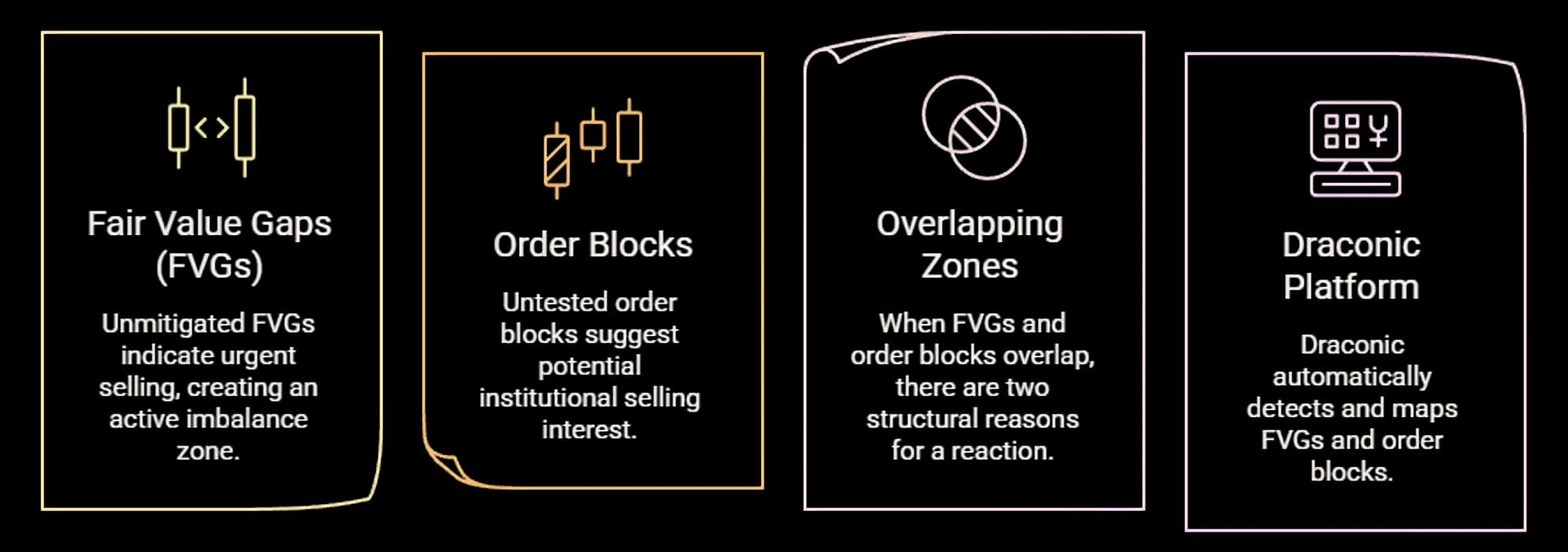
The combined read is where this framework becomes particularly useful. When an unmitigated FVG sits inside an untested order block, two independent institutional mechanics overlap at the same price. The FVG says the market moved through this range with urgency, creating an imbalance. The order block says institutions placed large orders here and likely have residual interest. Two separate structural reasons for the same level to hold.
But honest limitations matter here. Survivorship bias is real in SMC analysis. Traders remember the FVGs that filled perfectly and the order blocks that held on the first retest. They forget the ones that broke without hesitation. Neither FVGs nor order blocks are guaranteed reaction zones. They're probabilistic, and they work best as context within a broader analysis rather than as standalone trade triggers.
Reading Institutional Footprints Before Price Arrives
The practical value of fair value gaps and order blocks is that they shift level analysis from reactive to anticipatory. Instead of waiting for price to bounce and then drawing a line after the fact, traders can identify zones of probable institutional interest from chart structure before price returns. This changes pre-trade preparation and where you evaluate risk.
Next time you're evaluating a potential entry on BTC near a key level, check two things before committing. First, does an unmitigated FVG exist at or near the level? If price dropped sharply from $64,800 to $63,200 and left a gap between $64,200 and $64,500, that gap is a zone where selling was urgent enough to skip price discovery entirely. If price is now returning to $64,300, you're entering an active imbalance zone. Second, does an untested order block support the level? If the last bullish candle before the drop formed at $64,100, institutional selling interest may reassert near that zone.
When an FVG and an order block overlap, you have two structural reasons to expect a reaction. When neither is present, the level you're watching might be a line on a chart with no institutional memory behind it.
Draconic, an AI trading intelligence platform, detects both FVGs and order blocks automatically, mapping exact price boundaries and tracking whether each zone has been mitigated or remains untested.
Instead of scanning candles manually across multiple timeframes, a trader can ask Draconic what institutional footprints exist near a level they're watching. The response surfaces FVG boundaries, order block zones, and mitigation status alongside velocity, flow, and structural context. The zones are objective and derived from price structure, not drawn by hand and not subject to interpretation.
The Level Had a Reason
The bounce that had no visible explanation on your chart had a structural cause. An FVG marked where the market skipped price discovery. An order block marked where institutions entered. Both were readable before price returned, and the combination of both at the same level is what separates a line on a chart from a zone with institutional memory.
Fair value gaps and order blocks don't predict what price will do. They reveal where institutional activity left a structural imprint and where residual interest may still exist. The zones are identifiable in advance, and that changes when you plan and where you place risk.
See where institutional footprints appear on your instruments.
Frequently Asked Questions
What is the difference between a fair value gap and an order block?
A fair value gap is a price void where three consecutive candles failed to overlap, created by aggressive directional movement. An order block is the last opposing candle before an impulsive move, marking where institutional orders were placed. FVGs identify imbalance zones. Order blocks identify institutional entry zones. Both can exist independently or overlap at the same price level.
Do fair value gaps work on all timeframes?
FVGs form on every timeframe from 1-minute to daily. Higher-timeframe FVGs (15-minute and above) tend to carry more institutional significance because the volume required to create a gap on a higher timeframe is substantially larger. Lower-timeframe gaps form more frequently but produce less reliable reactions.
How do I know if an FVG or order block will hold?
Neither is guaranteed to hold. Mitigation status matters: untested zones carry higher probability than those already visited. Volume at the order block indicates participation strength. Zones that overlap with other structural signals, such as volume profile nodes or multi-timeframe alignment, have stronger odds than zones standing alone.
Are smart money concepts backed by academic research?
The specific terminology (FVG, order blocks) comes from ICT methodology, not academic literature. But the underlying behavior is well documented. Chan and Lakonishok (1995) showed that institutional trades create persistent price impact across sessions because large orders are split over time. Almgren and Chriss (2000) modeled why institutions split orders to minimize market impact. The mechanics are real. The labels are retail shorthand for observable institutional patterns.
Can FVGs and order blocks be used as standalone trading signals?
They work best as context within a broader analysis framework, not as isolated trade triggers. An untested order block with an overlapping FVG, supported by confirming signals from flow and momentum, represents a high-conviction level. The same order block without any other confirmation is a zone that might hold or might not. Survivorship bias in SMC analysis is significant, so context from other independent signal categories improves the odds.
More like this

September 9, 2026AI agents · Research
When an AI uses a tool, what happens to the evidence?
Abhinandan • 7 min read

July 4, 2026ai-trading
Chartink Alternative: Draconic vs Chartink
The Draconic Team • 6 min

July 4, 2026ai-trading
Sensibull Alternative: Draconic vs Sensibull
The Draconic Team • 6 min
May 12, 2026behind-the-price
Sector Rotation — The Macro Signal Most Traders Ignore
The Draconic Team • 3 min