 Back to Blogs
Will AI Change Market Dynamics Themselves?
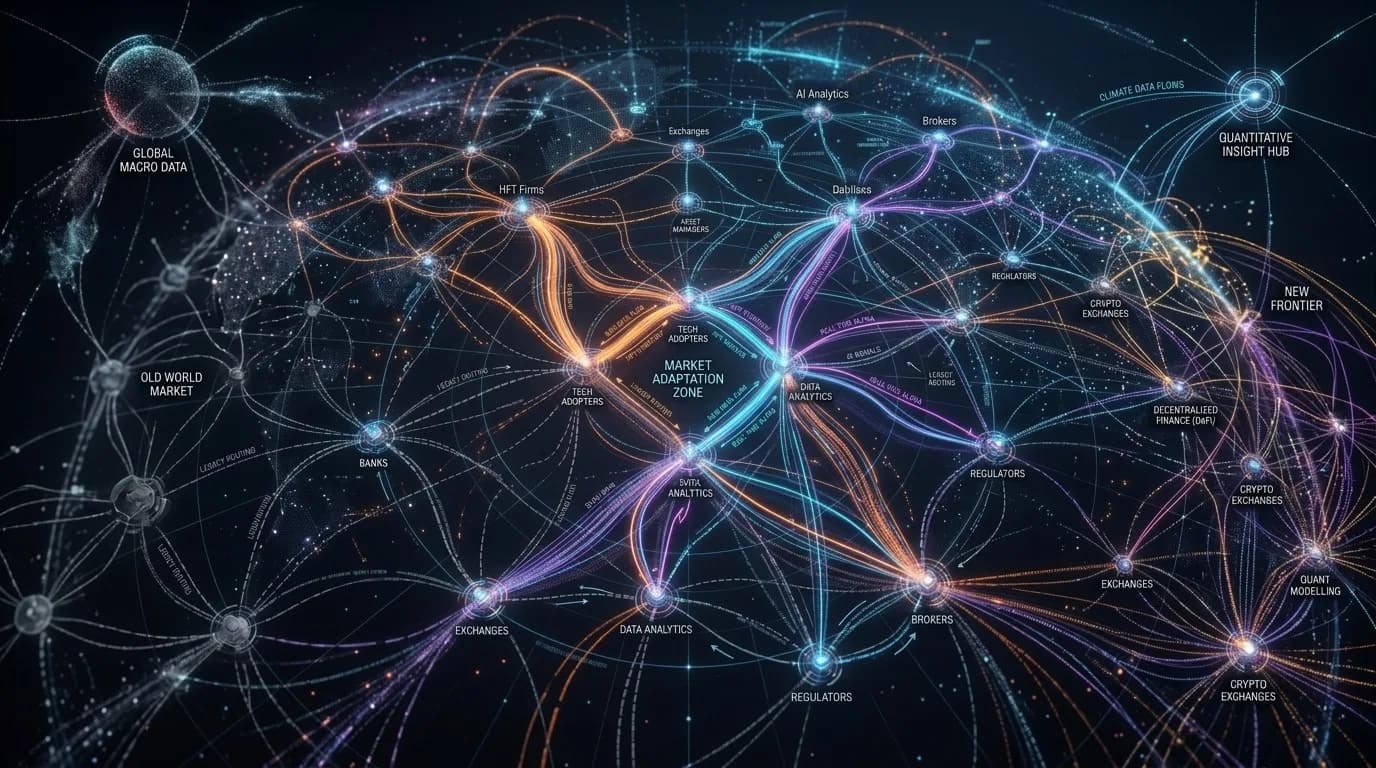
How will AI change stock market dynamics?
AI synthesis is the next structural shift after electronic trading and commission-free options — and the second-order effects will reshape behavior, not just speed. Three dynamics are already forming: exhaustion signals get crowded as more traders detect them simultaneously, institutional flow patterns become readable and force institutional adaptation, and the time between a pattern forming and being acted on compresses from hours to seconds. The durable edge shifts from spotting any single signal to adapting as signals evolve.
You're watching NIFTY stall at a level where velocity has decelerated across three successive swings, CVD is diverging from price, and options positioning shows a gamma flip forming just overhead. A year ago, you wouldn't have seen any of this without cycling through four different tools and ten minutes of manual synthesis. Now you're reading it in seconds. And somewhere in the back of your mind, a question forms: if you can see all of this, who else can?
That question points at something bigger than any individual trade. Every time a technology has changed what market participants can see, the market itself has reorganized around the new reality. Electronic trading in the early 2000s created HFT. Commission-free options in 2019 created the gamma squeeze. The AI impact on stock markets is shaping up as the next structural shift of that kind. The interesting question isn't whether it will happen, but what specifically will change.
What Happened Last Time a Technology Rewrote Market Structure
The transition from floor-based to electronic trading is the closest historical parallel to what AI synthesis represents, because it didn't just improve an existing process. It created fundamentally different market behavior that forced every participant to adapt or fall behind.
The SEC's Order Handling Rules of 1997 and Regulation NMS in 2005 opened US equity markets to electronic competition. Hendershott, Jones, and Menkveld published a study in the Journal of Finance in 2011 demonstrating that algorithmic trading improved liquidity and narrowed spreads for large-cap stocks. That was the first-order effect: more efficiency, lower costs, broader access.
The second-order effects were harder to predict. Tighter spreads forced market makers into higher-volume strategies to maintain profitability, which incentivized speed. Speed created high-frequency trading as a category. HFT strategies introduced patterns that hadn't existed when humans managed the book: latency arbitrage, layering, and the kind of cascading automated selling that the SEC and CFTC documented in their joint report on the May 6, 2010 flash crash. The technology was supposed to make markets fairer. It did, in many ways. It also created entirely new forms of fragility.
The pattern is consistent across every major transition: technology changes access, access changes behavior, behavior changes dynamics, and the new dynamics generate patterns that nobody anticipated when the technology was introduced. Retail options access in the US, dramatically expanded through commission-free platforms in 2019, led directly to the gamma squeezes of 2021, where concentrated retail options buying forced market maker hedging into a feedback loop that sent individual stocks to prices disconnected from any fundamental value.
AI synthesis is now changing access to market intelligence in a way that parallels these earlier transitions. And if the historical pattern holds, the second-order effects will be more consequential than the first.
Why Signals Degrade When Everyone Can See Them
When a profitable trading signal becomes widely visible, traders acting on it alter the market conditions that generated it. This is Goodhart's Law applied to financial markets: a measure that becomes a target ceases to be a reliable measure. Charles Goodhart articulated this in 1975 while advising the Bank of England, and the logic transfers directly to any trading signal.
It has already happened with simpler signals. Momentum strategies that generated consistent returns through the 1990s and 2000s degraded as factor-based investing scaled and billions of dollars chased the same patterns. Andrew Lo formalized this dynamic in his Adaptive Markets Hypothesis, published in the Journal of Portfolio Management in 2004: markets aren't efficient in a static sense, but they adapt. Strategies work until enough capital pursues them, at which point the ecosystem adjusts and new opportunities emerge elsewhere.
AI synthesis introduces a qualitatively different version of this dynamic, though. Previous waves of technology operated within fixed analytical frameworks. A moving average crossover system examines the same signal every time. A Bollinger Band squeeze fires on the same conditions regardless of what's happening in order flow or options positioning. AI synthesis that integrates velocity, flow, structure, positioning, and options data simultaneously creates a richer form of pattern recognition, one that operates across dimensions rather than within a single indicator family. The question is how markets adapt when this kind of multi-dimensional intelligence becomes broadly available.
The honest answer is that nobody knows for certain. But the historical precedents and the mechanics of signal degradation point toward three specific dynamics worth watching.
Where AI's Impact on Markets Will Show Up First
Three second-order effects of AI synthesis on market dynamics are already forming: the acceleration of exhaustion as more participants detect it simultaneously, institutional adaptation as flow patterns become readable to retail, and edge compression as pattern recognition timelines shrink from hours to seconds.
Exhaustion detection and the crowded exit. Today, most retail traders can't see statistical exhaustion forming in real time. They recognize it after the reversal, when it's obvious on the chart. If synthesis tools make exhaustion signals broadly visible (velocity at session extremes, swing durations expanding, multiple metrics clustering at statistical boundaries), the population of traders acting on those signals grows. When more participants recognize exhaustion at the same moment, the exit becomes crowded. Reversals could arrive sooner and land harder because the collective response to the signal compounds the selling pressure.
But there's a counterargument worth considering. If exhaustion signals consistently trigger faster exits, the trends that reach genuine climactic levels might become rarer. Moves could truncate earlier as participants take profits sooner, which means the thresholds that once marked climactic exhaustion might need to recalibrate. The signal adapts because the behavior adapting to it changes what constitutes an extreme.
Institutional flow readability and the adaptation race. SEBI's January 2023 study, "Analysis of Profit and Loss of Individual Traders dealing in Equity F&O Segment," found that 89% of individual traders in the derivatives segment incurred net losses over a three-year period, with aggregate losses exceeding ₹1.8 lakh crore. Part of this asymmetry comes from information gaps: institutions see order flow, positioning, and structural patterns that most retail traders historically couldn't access.
If AI synthesis narrows that gap by making CVD divergences, institutional order blocks, and options positioning readable to a wider audience, institutions face a strategic choice. They can change execution patterns to become less legible. They can shift toward strategies that don't rely on retail being uninformed. Or the informational edge can simply compress as more participants access the same intelligence.
History favors the first response. As detection of hidden institutional orders became more sophisticated through the early 2010s, institutions moved to increasingly complex execution algorithms that masked their true intent. The arms race didn't end. It escalated to a higher level of complexity.
Pattern recognition speed and the compression of edge. The third dynamic is temporal. When patterns required manual chart reading, the window between a pattern forming and enough participants recognizing it could span hours or days. AI synthesis compresses that window to seconds. A confluence of signals across five independent categories can be identified and acted on almost immediately.
This compression creates a paradox. If enough participants act on the same confluence signal at the same moment, their collective action IS the move. The pattern and the response to it merge. Price discovery happens faster, which is broadly efficient, but the traditional notion of "getting in early" on a pattern shrinks. The edge shifts from seeing the pattern first to understanding what happens after the pattern is already priced in.
Why the Durable Edge Shifts from Pattern to Synthesis
The practical takeaway isn't to avoid AI synthesis because signals might degrade. It's to recognize that rigid, single-pattern systems will degrade faster than adaptive ones, and to build accordingly. A trader who treats any individual signal as permanently reliable is constructing a system on ground that's already shifting beneath it.
This isn't a theoretical concern for the distant future. Options strategies that reliably captured premium in low-volatility regimes lost money when multiple short-volatility products were liquidated during the VIX spike of February 5, 2018. Momentum factors that outperformed for decades suffered their worst drawdown in 2020 when the pandemic scrambled every historical correlation. The pattern in both cases: a strategy that worked for years failed because the market structure underneath it changed.
What multi-dimensional synthesis offers isn't immunity from this cycle. It's faster recognition of when the cycle is turning. A trader who monitors confluence across independent dimensions doesn't depend on any single signal persisting. They depend on the ability to detect when dimensions align or conflict, and to adapt when the landscape shifts.
Draconic, an AI trading intelligence platform, was built around this principle. Rather than identifying fixed patterns, Draconic synthesizes across price dynamics, institutional flow, market depth, options positioning, and multi-timeframe structure simultaneously. The value isn't in any single signal. It's in the synthesis layer that integrates all of them and surfaces what's unusual for the current session, not against some historical baseline that may no longer apply.
That distinction matters more as markets adapt to AI. A system built on one pattern degrades when that pattern degrades. A system built on synthesis across independent dimensions has a structurally different relationship with market adaptation, because the degradation of any individual signal becomes visible in the context provided by all the others.
No one can predict exactly how AI synthesis will reshape markets over the next decade. The historical pattern is clear enough: every shift in how traders access and process information has changed the market itself. Electronic trading created HFT. Options democratization created the gamma squeeze. AI synthesis will create its own second-order effects.
The traders who navigate this transition won't be the ones who found the perfect signal before everyone else. They'll be the ones whose process adapts as signals evolve. That's always been the durable edge, and it's becoming more important, not less.
More like this
September 9, 2026AI agents · Research
When an AI uses a tool, what happens to the evidence?
Abhinandan • 7 min read
July 4, 2026ai-trading
Chartink Alternative: Draconic vs Chartink
The Draconic Team • 6 min
July 4, 2026ai-trading
Sensibull Alternative: Draconic vs Sensibull
The Draconic Team • 6 min
May 12, 2026behind-the-price
Sector Rotation — The Macro Signal Most Traders Ignore
The Draconic Team • 3 min