 Back to Blogs
The Trader's Workflow in 2026 — What's Different and What's Not
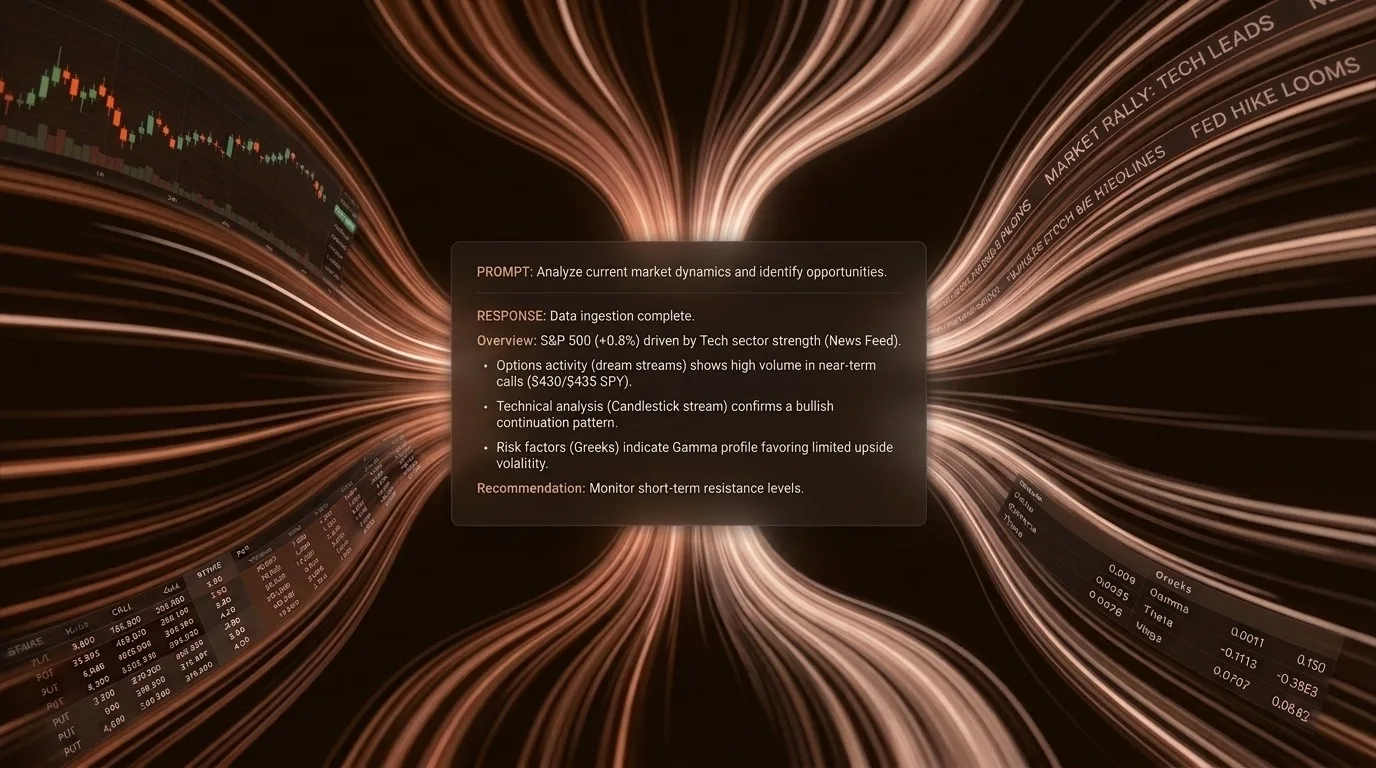
How does the day trading workflow change with synthesis-first tools?
The trader still owns every decision; what changes is how context arrives. Pre-market: instead of scanning six tabs (TradingView, NSE option chain, Sensibull Greeks, Telegram, journal, news), one question returns overnight futures context, OI shifts, value area position, gamma regime, and sector dynamics integrated. Mid-session: the 90-second pre-entry check across 15-minute structure, CVD, GEX levels, and breadth collapses to roughly ten seconds. Post-market: review reconstructs the data that was visible at the moment of exit — velocity, swing structure, flow — rather than scrolling backward with outcome knowledge baked in.
It's 8:30 AM. Markets open in 45 minutes. You've got TradingView on one screen, the NSE option chain in a browser tab, Sensibull open for Greeks, a Telegram group scrolling sentiment, yesterday's journal for key levels, and a news feed covering overnight developments. Six sources, each useful on its own, none connected to the others.
You scan left to right, running the same day trading workflow as every other morning, building a directional bias from fragments. Overnight futures are up, but put OI built heavily at the 23,400 strike and yesterday's POC sits below the projected open. The Telegram group is unanimously bullish. Your journal says caution near 23,400.
By the time you've processed the last tab, fifteen minutes have passed and you can't quite remember OI numbers from the first one. This workflow wasn't designed for how traders need to think. It was designed for how screens display data.
Why Sequential Scanning Fails Before the Market Opens
The bottleneck in most pre-market routines isn't access to data but the sequential nature of processing it. Scanning six sources one at a time forces a trader to hold earlier findings in working memory while evaluating new ones, and cognitive research has known since George Miller's 1956 paper in Psychological Review that working memory holds roughly seven items before degrading.
A serious pre-market assessment exceeds that limit comfortably. Overnight futures direction, OI concentration at three or four key strikes, yesterday's value area boundaries, sector rotation signals, news catalysts, and journal-based levels add up to eight or nine distinct inputs before the trader has even looked at a chart. By the time they reach the sixth tab, their recall of the first one has already started to blur.
The problem isn't the number of tabs. It's that no tool in the traditional workflow integrates what those tabs collectively mean. Each source answers its own narrow question ("what did OI do overnight?" or "where's yesterday's POC?") and the trader's brain becomes the synthesis layer, trying to weight and reconcile the answers under time pressure. Research from Daniel Kahneman's work on cognitive load, documented extensively in Thinking, Fast and Slow, demonstrates that decision quality degrades as unintegrated information sources multiply.
This is the structural flaw that a synthesis-first workflow addresses. Not by showing less data, and not by replacing the trader's judgment, but by handling the integration step computationally before the trader applies their own read.
The Pre-Market Routine on NIFTY: Six Tabs Versus One Question
A synthesis-first pre-market routine starts with a question rather than a screen. Instead of opening six tabs and mentally weighting what each one shows, the trader describes their situation and receives an integrated response covering options positioning, volume structure, overnight context, and sector dynamics together, already weighed against each other.
The shift is concrete. A NIFTY trader preparing for the 9:15 open traditionally checks overnight futures on one screen, navigates to NSE for option chain OI buildup at weekly expiry strikes, opens a volume profile from the previous session, scans news for RBI commentary or global macro events, reviews their own journal, and checks India VIX for the volatility regime. Each source takes two to three minutes. The full scan takes twelve to fifteen minutes, and the trader spends most of that time holding fragments in working memory rather than evaluating what they mean.
The synthesis version starts with "What should I focus on for NIFTY today?" and returns an integrated picture: overnight futures context, where OI shifted significantly, how yesterday's value area sits relative to the expected open, whether the gamma regime has changed, and any sector-level positioning that affects the index. The large majority of NIFTY index-options volume concentrates within three strikes of the current price, which means the OI picture at those nearby strikes matters far more than the full chain. A synthesis that highlights this weighting saves the trader from scanning dozens of strikes manually.
The information feeding both approaches is identical. The difference is whether the trader assembles the picture or receives it assembled, and whether twelve minutes of cognitive effort gets spent on integration or on the judgment that follows it.
Mid-Session on SPY: The Ten-Second Check Before the Click
The highest-value moment in any active session is the pause between identifying a setup and committing capital. In a fragmented workflow, that pause gets consumed by panel-switching: checking a higher timeframe, scanning CVD for aggressive participation, looking for nearby GEX levels, verifying market breadth. In a synthesis workflow, the same check takes one question and roughly ten seconds.
A SPY trader spots a pullback to demand at $523.40 on the 5-minute chart. The traditional process: flip to the 15-minute for context, check CVD for aggressive buying at the level, open the options chain for nearby gamma concentration, and glance at breadth to see whether the pullback is index-wide or sector-specific. That's four tools and about ninety seconds if they're fast, during which the pullback is developing in real time and the entry window is narrowing.
A 2020 SEC report on equity market structure documented that retail order flow concentrates disproportionately in the first and last 30 minutes of each session. These are the exact windows when price moves fastest and cognitive bandwidth is thinnest. The fragmented workflow demands the most attention at the moments when attention is scarcest. The velocity of the pullback, the CVD picture, higher-timeframe structure, and options positioning all matter for the entry decision, and none of them are visible from a single screen.
The synthesis version: "SPY pulling back to $523.40 on the 5-minute. What am I missing?" The answer covers velocity, order flow, the 15-minute structural read, and nearby GEX levels in one response. The trader still makes every call, but the information cost of making it well just dropped by an order of magnitude. And in a pullback that's developing in real time, ninety seconds and ten seconds aren't different speeds of the same process; they're different trades entirely.
Post-Market on BTC: What the Review Should Actually Reconstruct
Effective post-market review reconstructs the information that was available at the moment of each decision, not the outcome that followed it. Most review workflows fail this standard because they involve scrolling backward through charts with full knowledge of what happened next, which Kahneman's research on hindsight bias shows fundamentally distorts how we perceive prior uncertainty.
A BTC trader who exited a long at $68,500 and watched price run to $69,800 will naturally fixate on what they missed. But the relevant question isn't "why did I exit?" It's "what did the data actually show at exit?" If velocity was decelerating, swing duration had expanded to three times the session average, and CVD was flattening, the exit was reasonable regardless of what happened afterward. If velocity was still expanding, swing structure was intact, and flow supported continuation, the exit was premature and worth examining.
SEBI's 2023 study on F&O participant outcomes found that 89% of individual traders lost money over a three-year period. That number reflects not just flawed entries but the compounding effect of review processes that reinforce emotional patterns rather than correcting them. A trader who reviews outcomes instead of decision-state information learns to feel worse about losing trades without learning to make better ones.
A synthesis-based review changes the question entirely. "I exited BTC long at $68,500 at 2:15 PM. Was there a data-based reason to hold longer?" The response reconstructs what velocity, swing structure, and order flow showed at 2:15, not what became visible by 3:30. How many review sessions have actually changed the next day's decisions? That's the bar, and the traditional backward-scroll rarely clears it.
What Changes in the Day Trading Workflow and What the Trader Still Owns
The synthesis-first workflow changes how information arrives but not what the trader does with it. The pre-market bias is still the trader's call. The entry trigger is still their read. Stop placement and position sizing remain judgment decisions. What changes is the speed and completeness of the context feeding those decisions.
This distinction matters because the strongest objection to any new tool is "I don't want to overhaul my process." The process doesn't change. A trader who builds a pre-market bias from overnight data, OI shifts, and volume structure continues doing exactly that, because those are the right inputs. They just stop spending fifteen minutes assembling the picture from six separate sources and start spending those minutes on what the picture means.
The second opinion workflow before entry works the same way. The habit of pausing before committing doesn't change when the checking happens faster. It gains substance: a synthesis of independent signal categories rather than a gut check or a frantic scan across panels.
Draconic, an AI trading intelligence platform, makes this shift tangible. Here's what a pre-market synthesis looks like for NIFTY heading into an illustrative NIFTY expiry session:
One question. The response draws from the same data the trader would have found across six tabs, synthesized so each dimension is already contextual. The trader reads it, applies their own weighting to today's conditions, and starts the session with a bias built in seconds rather than minutes.
The daily trading workflow hasn't changed in its logic. Traders still prepare before the open, make decisions during the session, and review afterward. What's changed is that the integration step doesn't have to happen inside the trader's head anymore. The cognitive overhead of being the synthesis layer disappears, and what remains is the part only a human can do: deciding what to do with the picture.
See what a complete pre-trade synthesis looks like at draconic.ai.
More like this
September 9, 2026AI agents · Research
When an AI uses a tool, what happens to the evidence?
Abhinandan • 7 min read
July 4, 2026ai-trading
Chartink Alternative: Draconic vs Chartink
The Draconic Team • 6 min
July 4, 2026ai-trading
Sensibull Alternative: Draconic vs Sensibull
The Draconic Team • 6 min
May 12, 2026behind-the-price
Sector Rotation — The Macro Signal Most Traders Ignore
The Draconic Team • 3 min