 Back to Blogs
The Indicator That Sees 26 Candles Into the Future
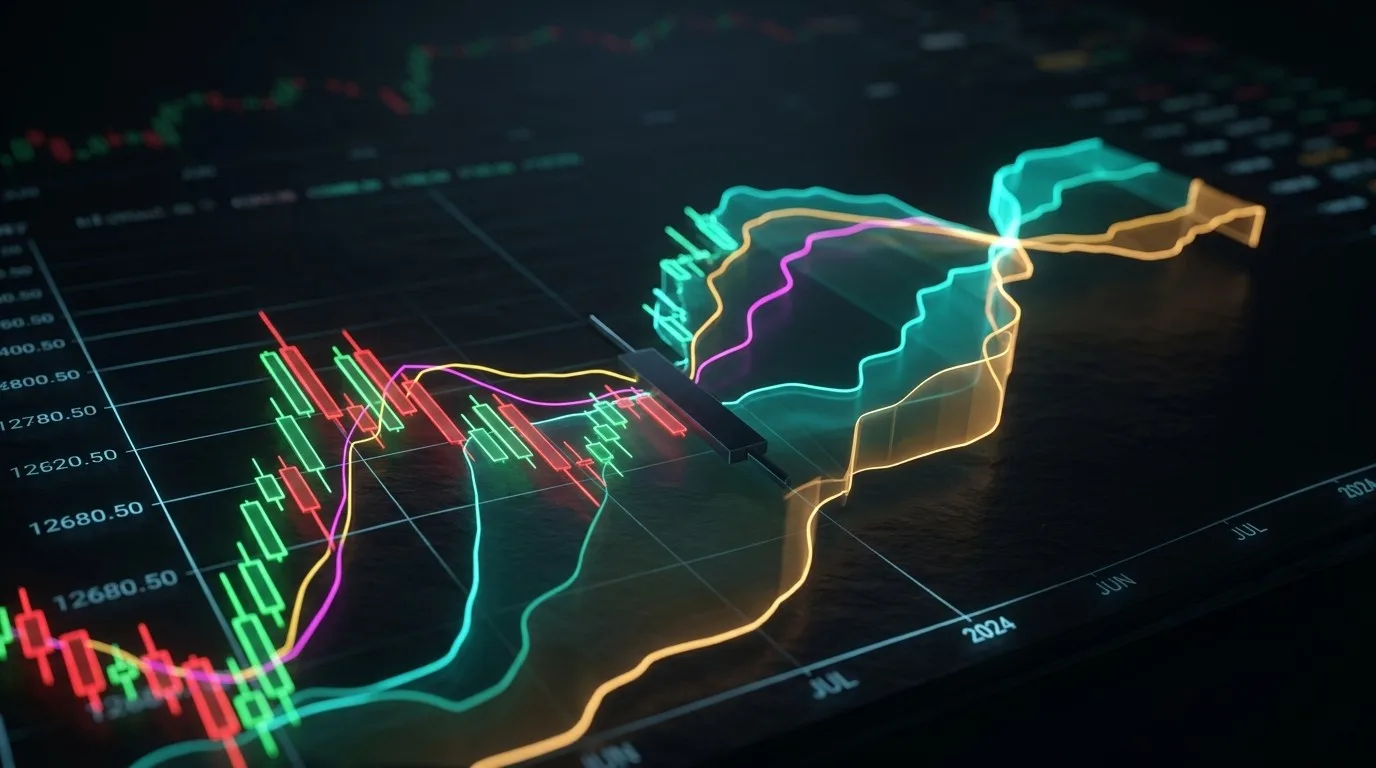
What is the Ichimoku cloud and why does it project forward?
Ichimoku Kinko Hyo is the only widely used indicator that plots support and resistance 26 periods ahead of current price, creating a map of friction zones before price arrives. It uses five components: Tenkan-sen (9-period equilibrium), Kijun-sen (26-period anchor), Senkou Span A and B (the forward-projected cloud), and Chikou Span (today's close plotted 26 periods back). Cloud thickness signals projected strength. A cloud twist — Span A crossing Span B in the forward zone — flags a regime change before price gets there.
You've watched price reverse at a level that made no sense. No trendline touched it. No prior swing high or low created it. No Fibonacci ratio lined up. You scanned your chart and found nothing to explain why price stopped there, reversed cleanly, and continued as though it had hit a wall only it could see.
There's an indicator that would have shown you that wall before price arrived. The Ichimoku Kinko Hyo system creates projected support and resistance zones that exist on your chart right now for price levels that haven't been tested yet. Not through extrapolation or prediction, but because part of the system is literally plotted 26 periods ahead of the current candle. Most traders either ignore Ichimoku entirely or reduce it to a single rule about price being above or below the cloud. That simplification strips away the most powerful thing the system does.
What Ichimoku's Forward Cloud Reveals About Levels Price Hasn't Reached
The Ichimoku cloud is the only widely used indicator that projects support and resistance forward in time, creating a map of where price is likely to encounter friction before it arrives. Senkou Span A and Senkou Span B, the two lines forming the cloud, are plotted 26 periods ahead of current price based on equilibrium calculations from recent market history.
That means the cloud sitting to the right of your most recent candle isn't decorative. It's a structural projection. When price reaches that zone hours or sessions from now, it encounters a boundary derived from the equilibrium of the last 9, 26, and 52 periods of price action. If the cloud is thick at that forward level, the projected support or resistance is structurally deep. If it's thin, the zone carries less weight and price is more likely to push through without friction.
Goichi Hosoda, a Tokyo-based journalist, developed the system over roughly three decades before publishing it in 1969. He and a team of assistants hand-calculated the components across years of Japanese equity and commodity data before computers made such analysis trivial. The result was a complete framework that captures trend direction, momentum shifts, equilibrium anchors, and forward-projected support and resistance in a single chart overlay. Steve Nison's Japanese Candlestick Charting Techniques (1991) introduced Japanese technical methods to Western audiences and noted that Ichimoku had become the dominant analytical framework in Japanese equity markets by the time of publication, used more widely than any Western indicator system.
Reducing all of that to "price above cloud equals buy" is like reducing a balance sheet to one line item and calling it analysis. The simplified rule captures roughly 20% of the information the system generates.
Tenkan, Kijun, Cloud, and Chikou: What Each Component Actually Measures
Ichimoku contains five components, and each answers a different question about price's relationship to its own recent history. The Tenkan-sen measures short-term equilibrium, the Kijun-sen anchors medium-term range, the cloud projects that equilibrium forward in time, and the Chikou Span confirms trend momentum against past price action.
- The Tenkan-sen calculates the midpoint of the highest high and lowest low over the last 9 periods. It isn't a moving average. It captures where price's short-term range center sits right now, making it a fast equilibrium line. When price deviates sharply from the Tenkan, it's stretched relative to its own recent behavior and the probability of a mean-reversion snap increases.
- The Kijun-sen performs the same calculation over 26 periods. Because it reflects a wider range, it moves more slowly and functions as a stronger equilibrium anchor. When price pulls away from the Kijun and returns to it, that return is one of the highest-probability setups in the system. Manesh Patel's Trading with Ichimoku Clouds (Wiley, 2010) documents this tendency across equity and forex markets, noting that Kijun tests during intact trends produce measurable continuation rates when the broader structure hasn't broken.
- The TK Cross, when the Tenkan crosses above or below the Kijun, signals that short-term equilibrium has shifted relative to the medium-term anchor. This is the earliest momentum signal in the system and functions similarly to a MACD crossover, but it's built from range midpoints rather than exponential moving averages. A TK cross that occurs above the cloud carries substantially more weight than one inside or below it, because the cloud itself provides the trend context that validates the momentum shift.
- Senkou Span A averages the Tenkan and Kijun values and plots the result 26 periods forward. Senkou Span B takes the midpoint of the highest high and lowest low over 52 periods and plots that 26 periods forward. Together they form the cloud. The space between them represents the projected equilibrium zone. Above the cloud, price is in bullish territory relative to its own historical balance. Below, bearish. Inside the cloud, the market is in structural transition and directional trades carry higher uncertainty.
- The Chikou Span plots the current close 26 periods into the past. It answers whether today's price is higher or lower than where it was 26 periods ago. When the Chikou sits above past price action, the trend has upward momentum over that lookback. When it's below, the reverse. The Chikou also interacts with past candles as dynamic support and resistance, creating reaction zones that are difficult to identify with any other method.
For BTC on the daily chart, a Kijun test near $62,400 with the Chikou still cleanly above past price and a TK cross holding bullish gives three Ichimoku components pointing toward continuation before any Western oscillator has generated a signal.
Why the Cloud Twist Signals a Trend Change Before It Arrives
The cloud twist occurs when Senkou Span A crosses Senkou Span B in the projected portion of the chart, 26 periods ahead of the current candle. Because both spans are plotted forward, this crossing signals a shift in the equilibrium landscape before price encounters it. No other standard indicator provides a structural trend-change signal in the forward-projected area.
When the cloud twists from bearish (Span B above Span A) to bullish (Span A above Span B) in the projected zone, the system's equilibrium math is telling you that the support and resistance landscape price will meet in 26 periods has fundamentally changed character. Traders who watch for twists can see these shifts one to several sessions before price reaches the new configuration.
Cloud thickness at any projected point represents the distance between Span A and Span B. A thick cloud means strong projected friction. A thin cloud or a twist point means structural weakness. When price approaches a thin section of the future cloud, the probability of a clean break increases because the equilibrium zone has less depth to absorb the move. Conversely, a thick future cloud at a nearby price level suggests that significant velocity would be needed to push through, which connects directly to the question of whether a move's speed can sustain itself through structural resistance.
Reading Ichimoku as Part of a Pre-Trade Synthesis
Ichimoku works best as a context layer rather than a standalone entry system. Its projected zones, momentum signals, and equilibrium anchors gain substantially more conviction when they align with independent data sources from entirely separate analytical dimensions, such as velocity, order flow, and structural analysis.
Consider NIFTY pulling back toward a thick future cloud zone near 23,500. The Kijun sits at 23,480, and the most recent TK cross is bullish above the cloud. Ichimoku reads this as structurally strong projected support. But that read becomes something different when you also know that velocity into the pullback is decelerating (the move toward the cloud is losing speed), CVD is showing aggressive buying resuming at that level, and the 15-minute trend structure remains intact with no CHOCH detected. Three independent analytical dimensions pointing to the same level as significant is a different kind of conviction than one indicator alone can provide.
The natural question before entering a trade near a cloud level isn't just "what does Ichimoku show?" It's whether the velocity picture, the flow picture, and the structural picture agree with what Ichimoku is projecting. That synthesis across genuinely independent categories separates a single-indicator trade from a multi-dimensional one.
Draconic, an AI trading intelligence platform, synthesizes Ichimoku readings alongside velocity percentile, order flow, structural analysis, and options positioning in a single view. Rather than switching between a cloud chart, a CVD panel, and a separate options screen to build the full picture manually, a trader can ask what the confluence looks like at a specific level and receive the Ichimoku context integrated with every other dimension Draconic tracks.
For SPY approaching a cloud twist at 532, seeing that the projected cloud shifts from bearish to bullish at that level while velocity is expanding into the move and the Kijun holds as support on the pullback creates a convergence of context across the Ichimoku framework and independent price dynamics. That convergence is visible in one synthesis rather than spread across three separate chart overlays that a trader has to mentally stitch together.
The invisible wall that reversed price cleanly wasn't invisible to everyone. Ichimoku had projected that zone before the candle that tested it had even formed. The system's real value isn't in the simplified trend-filter heuristic that most traders learn first. It's in the forward projection that provides structural context for levels price hasn't reached, the cloud twist that signals equilibrium shifts before they arrive, and the Kijun anchor that quantifies where mean-reversion is most probable. When those readings combine with velocity, flow, and structure from independent dimensions, the picture becomes something no single overlay can generate alone.
More like this
September 9, 2026AI agents · Research
When an AI uses a tool, what happens to the evidence?
Abhinandan • 7 min read
July 4, 2026ai-trading
Chartink Alternative: Draconic vs Chartink
The Draconic Team • 6 min
July 4, 2026ai-trading
Sensibull Alternative: Draconic vs Sensibull
The Draconic Team • 6 min
May 12, 2026behind-the-price
Sector Rotation — The Macro Signal Most Traders Ignore
The Draconic Team • 3 min