 Back to Blogs
Why Your Trend Indicator Is Lying
How do you confirm whether a trend has real quality?
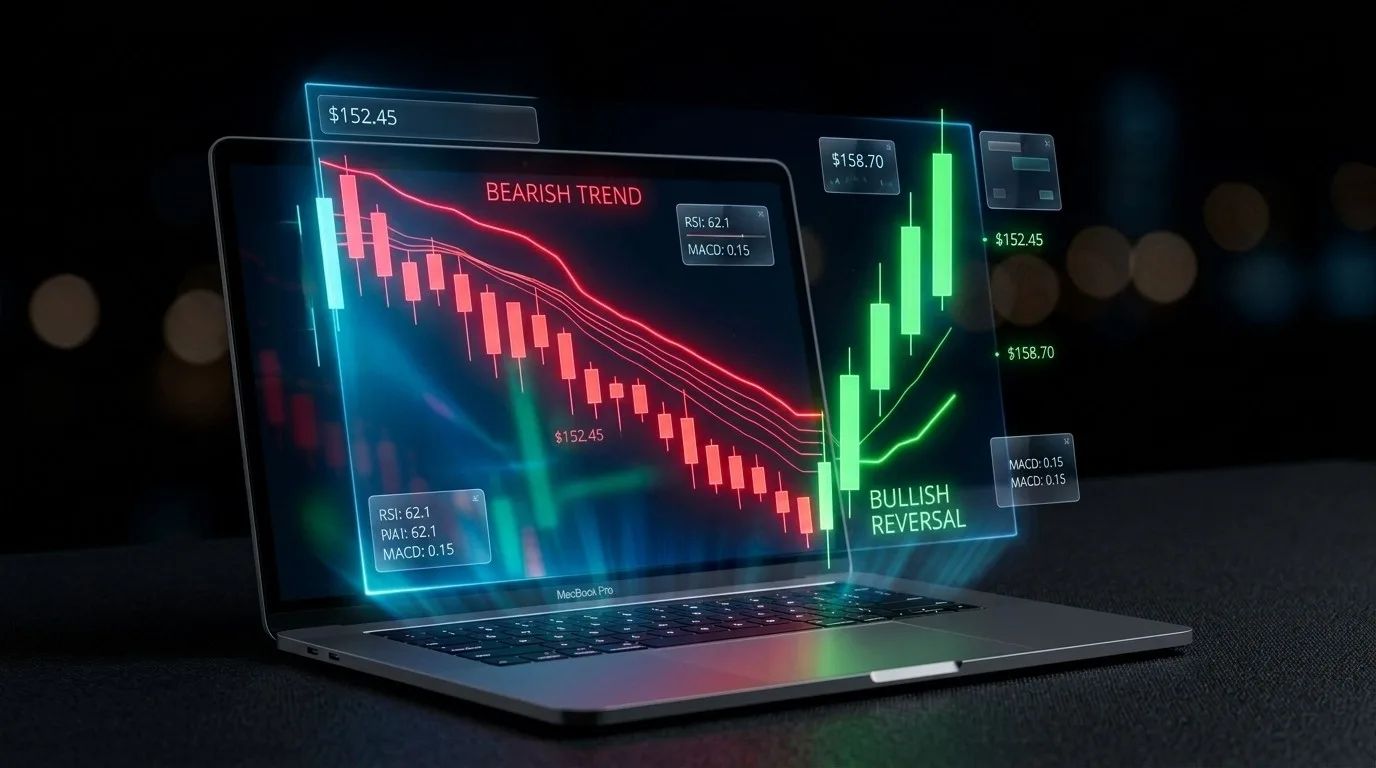
Trend indicators show direction, not quality. A move can look bearish on Supertrend, every EMA, and RSI yet snap 200 points the wrong way because the underlying market is balanced, not dominant. Three metrics separate real trends from drift: move symmetry score below 0.50 (one side actually winning), swing magnitude z-score above 2.0 (structural expansion behind the move), and linear regression R-squared above 0.70 (clean directional path). All three aligning with the signal is the difference between following a trend and getting trapped.
Supertrend has been bearish for 19 consecutive bars, price sits below every moving average on your chart, and RSI reads 38 and falling. Every trend indicator on the screen agrees: short.
So you're short. And then NIFTY snaps 200 points higher in four candles, blowing through your stop and reversing the session's entire move.
The indicators all confirmed the trend, they were in perfect agreement, and they were all wrong. Not because they malfunctioned, but because they answered the wrong question. They showed direction. They didn't show trend quality: whether the move had genuine one-sided dominance behind it, or was a balanced grind masquerading as a trend. That distinction is what most trend-following traders never measure, and it's the reason false breakouts take their money with such reliability. These metrics reveal it before the stop gets hit.
When Direction Disguises a Balanced Market
Move symmetry score quantifies how much of each directional push gets retraced by the opposing side, on a scale from zero to one. Below 0.50, one side genuinely dominates and the trend tends to continue. Above 0.70, each swing is absorbed almost entirely by the opposing force, and what appears directional is a balanced market drifting.
Here's what that looks like in practice. SPY drops 1.2% over three hours. Supertrend is bearish, all EMAs slope down, RSI sits at 35. But inside that decline, for every 10-point drop, price retraces 7 points before resuming lower. Buyers aren't gone. They're absorbing 70% of every selling push, and the net result is downward drift rather than directional dominance. It's a tug-of-war with a slight lean, and slight leans are inherently unstable.
Park and Irwin's 2007 meta-study of 95 technical analysis studies in the Journal of Economic Surveys found that trend-following trading rules showed declining effectiveness over time, particularly in developed markets. One explanation: as more participants trade the same directional signals, the quality of the trends those signals capture deteriorates. The indicators still fire. But what they're catching is increasingly noise dressed as direction, and no standard trend indicator distinguishes between the two.
Supertrend calculates a trailing level based on ATR. EMA slopes track the average direction. RSI measures the ratio of up-closes to down-closes. Even velocity, which measures how fast swings are forming within a session, captures speed rather than dominance. All of these answer the question "where is price going?" None of them answer "is one side actually winning, or are both sides fighting to a draw?"
The Structural Test False Breakouts Fail
Swing magnitude z-score measures whether the size of each swing is expanding or contracting relative to the session average, expressed in standard deviations. A genuine breakout produces expanding swings with z-scores above 2.0, meaning the structural energy behind the move is statistically abnormal. When a trend indicator flips but swing magnitude stays near zero, nothing structural has actually changed.
Consider BTC breaking below a two-day range on the 15-minute chart. Supertrend flips bearish. Price drops through the prior session's low. Traders pile on short. But the swing that carried price through that level is almost exactly the size of the average swing from the previous four hours. There's no expansion, no structural break. The move that triggered every trend indicator was statistically indistinguishable from the routine oscillations that preceded it, and it reversed within the hour.
A z-score above 2.0 means the swing is larger than roughly 95% of recent swings for that instrument in that session. That's the minimum threshold for structural expansion. When it appears alongside a Supertrend flip or an EMA alignment change, the combination carries genuine weight because two independent measurements agree: direction changed and the structural energy behind it is abnormal. When the z-score sits near zero at the moment of a trend signal, you're looking at a drift that happened to cross an indicator threshold without any underlying change in market character.
This connects to a broader pattern in how false breakouts form. SEBI's January 2023 study, 'Analysis of Profit and Loss of Individual Traders dealing in Equity F&O Segment', covering FY19 through FY22, found that 9 out of 10 lost money. A meaningful portion of those losses accumulate through trend-following entries that trigger at exactly the wrong moment: the breakout that carries no structural expansion behind it, followed by a snap reversal that takes the stop. The indicator worked as designed. It detected direction. But direction alone, without a read on whether the structural energy behind the move was genuinely abnormal, is an incomplete basis for a trade.
There's a third metric that ties the picture together. Linear regression R-squared, applied to the price series over a lookback period, measures how cleanly price follows a straight line on a scale from zero to one. An R-squared of 0.90 means price is moving in a nearly straight directional line with minimal noise. An R-squared of 0.45 means roughly half the movement is directional and half is random chop. When you read all three metrics together, the quality picture becomes specific: symmetry below 0.50 (one-sided dominance), swing magnitude z-score above 2.0 (structural expansion), and R-squared above 0.70 (clean directional path). A trend with those numbers behind it is worth following. A trend indicator signal without any of them is a coin flip wearing a costume.
What Changes When You Can Measure Trend Quality
Measuring trend quality before committing to a position changes the entry decision from a binary signal into a conditional one. Instead of entering whenever Supertrend flips or EMAs align, you enter only when the structural evidence supports the signal. The practical result is fewer trades, but a higher proportion of them survive the first hour.
The immediate application is a filter on every trend-following entry. Before you commit, check two numbers: symmetry score and swing magnitude z-score. If symmetry is above 0.65, the market is too balanced for confident trend trading regardless of what the indicators show. If swing magnitude z-score is below 1.5 at the point of the trend signal, there's no structural expansion behind the move. Either condition is a reason to wait, reduce size, or look for a different setup entirely.
This filter works across instruments and timeframes. NIFTY on the 15-minute, SPY on the 5-minute, BTC on the hourly. The specific thresholds shift slightly by volatility regime, but the principle holds: a trend signal without structural dominance behind it is unreliable. Adding R-squared as a third layer tightens the filter further, and flow-based confirmation from metrics like CVD can contribute an independent dimension of evidence. When structural quality and order flow both align with the trend signal, you're looking at a genuine directional move with measurable quality behind it.
This is where synthesis across multiple dimensions makes the assessment practical rather than theoretical. Draconic, an AI trading intelligence platform, calculates symmetry score, swing magnitude, and R-squared alongside 176+ other metrics per candle across timeframes. Instead of manually checking each measurement against your trend signal, a single query surfaces the full trend quality picture for any instrument in seconds.
The contrast is what makes these numbers actionable. A Supertrend flip where symmetry reads 0.42, swing magnitude z-score hits 2.3, and R-squared sits at 0.87 is a qualitatively different signal from one where symmetry reads 0.73, swing magnitude hovers at 0.4, and R-squared lands at 0.51. Both trigger the same indicator. Only one has a trend behind it. Seeing all three numbers before committing turns the entry from a reaction into a decision, and the second opinion habit applied to trend quality becomes one of the simplest structural improvements a trader can make.
Trend indicators don't lie about direction. They lie by omission, showing where price has been going and leaving out whether anyone is genuinely driving it there. Symmetry score, swing magnitude, and R-squared fill that gap with numbers instead of guesses. The next time every indicator on your screen agrees, ask the question they can't answer: is this a trend, or is this just a market drifting?
More like this

July 4, 2026ai-trading
Chartink Alternative: Draconic vs Chartink
The Draconic Team • 6 min

July 4, 2026ai-trading
Sensibull Alternative: Draconic vs Sensibull
The Draconic Team • 6 min
May 12, 2026behind-the-price
Sector Rotation — The Macro Signal Most Traders Ignore
The Draconic Team • 3 min
May 11, 2026behind-the-price
How Market Makers Create Invisible Floors and Ceilings
The Draconic Team • 11 min