 Back to Blogs
Can Individual Traders Compete With Institutions?
Why do 89% of retail F&O traders lose money?
SEBI's 2023 study of 1.5 crore traders found 89% lost money over three years, averaging ₹1.1 lakh annual loss per person. The cause is architectural, not intellectual. Three traditional institutional advantages — speed, data access, risk infrastructure — have largely compressed for retail through co-location access, retail terminals, and standard broker tools. Synthesis is the one that hasn't. Institutions integrate price, flow, options positioning, depth, and multi-timeframe structure into a single decision view; retail traders see price alone and infer the rest by tab-switching. One dimension against five produces the loss rate the data shows.
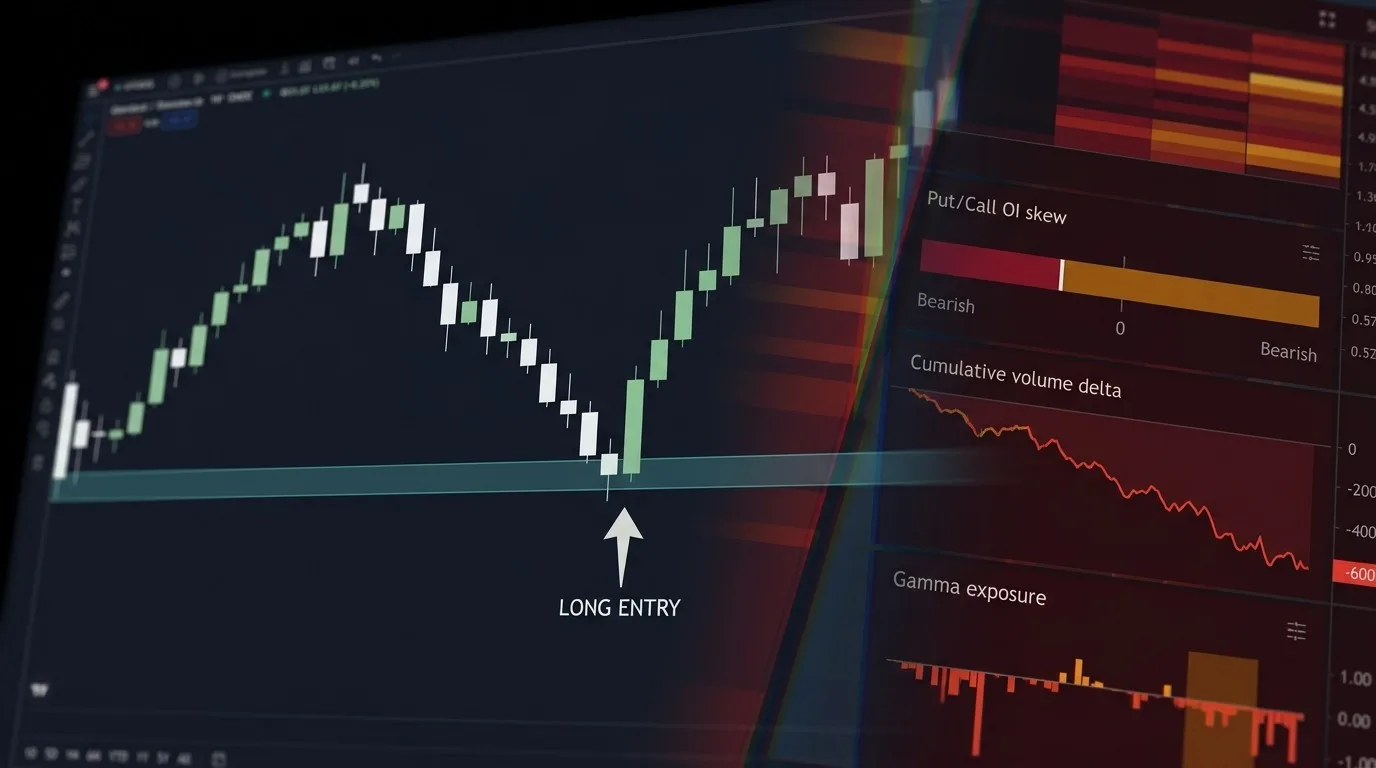
The chart looked right. Price had pulled back to a level that held twice before, volume was drying up on the decline, and RSI was curling from oversold. You took the long. Four minutes later, price sliced through your level without pausing and your stop was hit.
Nothing on the chart explained it. Beneath the surface, three data dimensions had pointed the same direction, invisible on a standard chart. SEBI quantified the cost in 2023: 89% of individual F&O traders lost money over three years. Why retail traders lose is a question with a structural answer, and it begins with information architecture, not strategy or psychology.
Why Retail Traders Lose: It's Architecture, Not Intelligence
The difference between consistently profitable institutional desks and consistently unprofitable retail traders is not talent, education, or even capital. It is information architecture: how many market dimensions are visible simultaneously and how fast they synthesise into a decision. Institutions see price, flow, positioning, depth, and structure as one integrated picture. Most retail traders see price alone and infer everything else.
This distinction matters because it changes what "competing" means. A retail trader watching a 5-minute chart is not playing a simpler version of the same game an institutional desk plays. They're playing a different game with different information, and the outcomes reflect that difference precisely.
SEBI's 2023 study on F&O profitability examined 1.5 crore traders across three financial years. The finding was unambiguous: 89% lost money, with an average annual loss of ₹1.1 lakh per person. The remaining 11% who were profitable included a heavy concentration of algorithmic and institutional participants. The data doesn't suggest retail traders are bad at trading. It suggests the structural conditions produce this outcome with remarkable consistency.
An NSE Centre for Excellence working paper examining intraday order flow found that trades classified as institutional showed significantly higher execution quality and adverse selection avoidance than retail-originated orders. The gap wasn't in strategy selection. It was in the information available at the moment of decision.
Three Advantages That Have Compressed — and One That Hasn't
Three of the four traditional institutional advantages have compressed significantly, and in some cases dramatically, in the past decade: speed, data access, and risk infrastructure are now available to retail traders through standard platforms and vendors. Synthesis is the exception, and it has widened as the volume of available data has grown faster than any individual's ability to integrate it.
Speed was once a genuine moat. Co-location, direct market access, and sub-millisecond execution were institutional-only capabilities that gave large firms a measurable edge in order routing and fill quality. SEBI's 2019 framework for co-location and DMA access reduced some of that asymmetry by standardising exchange-level access. Retail brokers now offer execution speeds that would have qualified as institutional-grade a decade ago. For any strategy operating above the scalping timeframe, speed is no longer the differentiator it was.
Data access followed a similar path. Options chain data, historical tick data, order book depth, and volume analytics that once required Bloomberg terminals or proprietary exchange feeds are now available through retail platforms and data vendors. The SEC's 2020 report on equity market structure noted that data accessibility for retail participants had increased substantially, though it also observed that raw access and analytical capacity are not the same thing. The data is available. What hasn't equalised is the ability to process it.
Risk infrastructure has compressed through technology. Position sizing calculators, automated stop-loss execution, margin monitoring, and portfolio risk dashboards are standard features in most retail trading platforms. The tools that institutional risk desks used to enforce discipline are now accessible to anyone with a brokerage account. Whether individual traders actually use them consistently is a discipline question, not an access question.
Synthesis is the exception to the compression trend. Institutional desks don't analyse one dimension at a time. A single trade decision on a prop desk integrates price structure, momentum across timeframes, options positioning, order flow direction, sector context, and volatility regime simultaneously. This isn't because institutions have smarter people. It's because their infrastructure feeds these dimensions into one view, pre-synthesised, so the decision happens against a complete picture rather than a partial one.
Retail traders have access to each of these data sources individually. They can open a chart in one tab, an options chain in another, order flow data in a third, and sector performance in a fourth. But the synthesis step, the integration of all these dimensions into a single coherent read at the moment of decision, still happens manually, sequentially, and incompletely. By the time a retail trader has checked four sources and formed a view, the conditions that prompted the check may have already changed.
This is the structural explanation for why retail traders lose at the rate SEBI documented. It isn't that the data is unavailable. It's that the synthesis of data into an integrated decision happens at fundamentally different speeds and depths depending on your infrastructure. One chart dimension against seven synthesised dimensions produces exactly the outcome distribution the data shows.
What Retail Trading Looks Like With a Synthesis Layer
Retail-accessible synthesis means the process collapses from six tabs to one question, with price structure, flow, options positioning, and momentum across timeframes arriving pre-integrated before the decision moment. The difference isn't more data. It's data that has already been synthesised, so the trader evaluates a complete picture rather than assembling one from fragments.
Consider the trade from the opening of this article. A pullback to a level that held twice, declining volume on the pullback, RSI curling from oversold. On a standard chart, that's a clean setup. But an integrated synthesis of that same moment reveals what the chart alone couldn't show: open interest building on downside strikes below the entry level, CVD declining even as price consolidates, and an institutional order block from a prior session sitting just below support. Three independent data dimensions, all contradicting the chart's apparent strength, all available before the entry.
The architecture gap narrows when synthesis happens before the trade decision rather than after the loss. Draconic, an AI trading intelligence platform, integrates price dynamics, institutional flow, market depth, options positioning, and multi-timeframe structure into a single response. One question replaces the tab-switching workflow.
The screenshot shows what the opening trade would have looked like through a synthesis layer. The chart pattern was valid in isolation. The other four dimensions told a different story, and they told it before the stop was hit. That's the structural gap this article describes, and it's no longer a fixed condition.
The 89% loss rate SEBI documented isn't a verdict on retail intelligence. It's a measurement of what happens when one side of the market sees four dimensions and the other side sees one. The speed, data, and risk advantages have compressed. The synthesis advantage is the one that remained, and it's the one that most directly determines whether the information available at the moment of decision is complete or partial.
That gap is closable now in ways it wasn't five years ago.
Understand what institutional-grade synthesis looks like — explore Draconic.
More like this
September 9, 2026AI agents · Research
When an AI uses a tool, what happens to the evidence?
Abhinandan • 7 min read
July 4, 2026ai-trading
Chartink Alternative: Draconic vs Chartink
The Draconic Team • 6 min
July 4, 2026ai-trading
Sensibull Alternative: Draconic vs Sensibull
The Draconic Team • 6 min
May 12, 2026behind-the-price
Sector Rotation — The Macro Signal Most Traders Ignore
The Draconic Team • 3 min